4.4.1What is the area between curves?

Area Between Curves

4-128.

Set up integrals and calculate the exact areas for each of the shaded regions shown.
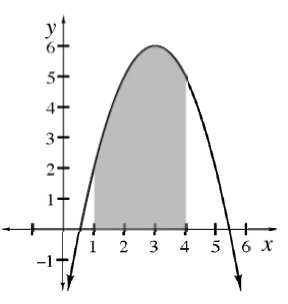
  1. f(x)=x2+6x3

    Downward parabola, vertex at the point (3, comma 6), shaded region below the parabola, above the x axis, right of x = 1 & left of x = 4.

  1. g(x)=x+1

    Increasing line, passing through the points (0, comma 1), (4, comma 5), shaded region below the line, above the x axis, right of x = 1 & left of x = 4.

  1. Between f(x) and g(x)

    Downward parabola, vertex at the point (3, comma 6), & Increasing line, passing through the points (0, comma 1), (4, comma 5), intersecting at the points (1, comma 2 ) & (4, comma 5), with shaded region below the parabola, above the line, & between points of intersection.

4-129.

First quadrant, 2 intersecting curves, concave up labeled, g of x, concave down labeled, f of x, with tick marks on x axis, corresponding to the points of intersection, labeled, a, & b, shaded vertical rectangle with top left vertex on, f of x, & bottom left vertex on, g of x, about a third right of left intersection. AREA BETWEEN TWO CURVES

To calculate the area of the region between two curves, a limit of a sum of rectangle areas is taken. A typical rectangle is shown in the diagram at right.

  1. Copy the diagram onto your paper. Label the rectangle with its length, width, and area.

  2. Set up an integral that will calculate the area between the curves for axb.

  3. What do a and b represent?  

4-130.

 Sketch the graph shown below and shade the region bounded by f(x)=(x3)21 and g(x)=x+8.

  1. Upward parabola, vertex at the point (3, comma negative 1), & decreasing line intersect each other at the points (0, comma 8), & (5, comma 3), shaded region below the line, above the parabola, & between the intersection points.On your diagram, draw a typical rectangle. Label the rectangle with its dimensions and calculate its area.

  2. Set up and evaluate an integral to calculate the area of the shaded region. Check your solution with your graphing calculator.

  3. Even though y=f(x) dips below the x-axis, explain why we do not subtract off this portion. 

4-131.

Given f(x)=x and g(x)=x26:

  1. Set up and evaluate an integral to calculate the area bounded by the curves in Quadrant IV. 

  2. Explain why the area is positive even though the graphs are below the x-axis.

4-132.

Calculate the area of each of the enclosed regions below. A complete solution includes:

  • A sketch with the shaded region.

  • A typical rectangle with width and length labeled.

  • An integral expression to add up the areas of all rectangles.

  • An analytical solution, checked with a graphing calculator.

  1. The area between y=(x3)2+9 and y=x+6.

  2. The area between y=sin(x) and y=x21.

4-133.

Describe how to determine the bounds of integration when calculating the area between two curves.

Review and Preview problems below

4-134.

Examine the following integrals. Consider the multiple tools available for evaluating integrals and use the best strategy for each part. Evaluate each integral and briefly describe your method. Homework Help ✎

  1. 523m3+2m29mmdm

  2. 12t(2t+3)dt

  3. 41(1+1x)2dx

  4. 23(ax+b)dx

4-135.

The area under the graph of the function f from t=0 to t=x can be calculated using the function F(x)=3(x4)3+6. What is the equation of f(t)? Explain how this is an application of the Fundamental Theorem of Calculus. Homework Help ✎

4-136.

Horizontal segment, with 2 concentric semicircles with the diameters on the right 2 thirds of the segment, region between semicircles is shaded, radius of smaller semicircle is 3, radius of larger semicircle is 4.A horizontal flag is shown at right. The radius of the outer semicircle is 4. The radius of the inner semicircle is 3. Homework Help ✎

  1. Imagine rotating the flag about its pole and describe the resulting three-dimensional figure. Sketch this figure on your paper.

  2. Calculate the volume of the rotated flag.

4-137.

Graph y=g(x), given below, and determine if g is differentiable at x=2. Homework Help ✎

g(x)={(x1)2 for x<22sin(x2)+1 for x2

4-138.

As a log falls in a waterfall, its velocity is given by v(t)=32t18 in feet per second. The position of the log at time t=0 was at the top of the waterfall, 500 feet above sea level. 4-138 HW eTool  Homework Help ✎.

  1. Where is the log after 1 second? 2 seconds? 3 seconds?

  2. Where is the log after t seconds? This is the position function. What is its relationship to the velocity function?

4-139.

Write a complete set of approach statements for the following functions. Also, write the equations of any end-behavior functions. Homework Help ✎

  1. f(x)=x22x3x2

  2. f(x)=cos(x)x

4-140.

Does ddx((x3)(2x+9))=ddx(x3)ddx(2x+9)? Test your conjecture. Homework Help ✎

4-141.

Evaluate each of the following limits. Homework Help ✎

  1. limx9x3x9

  2. limh02+h2h

  3. limx2x+15x

  4. limxcos(x)